
Authors: Irene Dei Tos, Angelica Simbula, Julian Guerrero, Thanh Dong, Sownder Subramaniam, Beatriz de la Fuente, Vishal K. Jose, Yinghuan Kuang, Tom Aernouts, Negar Naghavi, Sudhanshu Shukla, and Bart Vermang
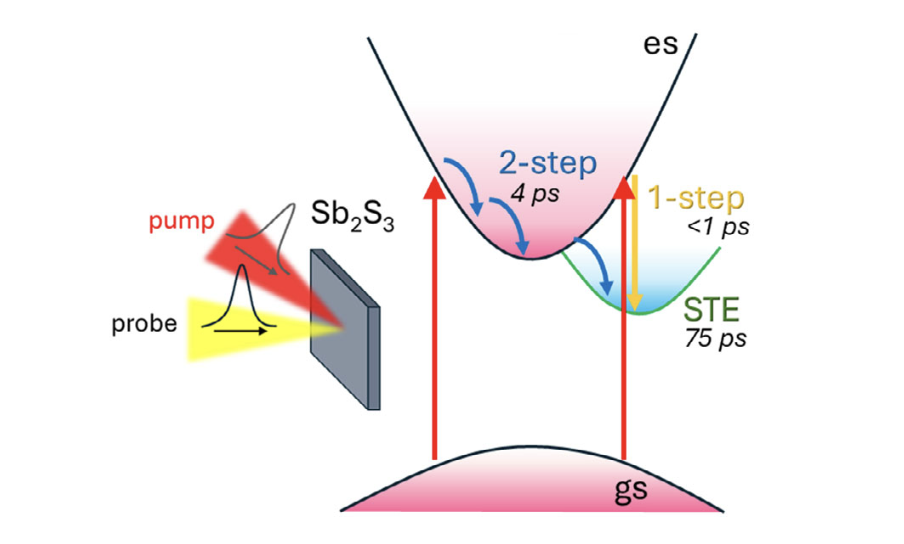
This study explores how to improve the performance of antimony trisulfide (Sb₂S₃) as a photoanode material for solar-driven water splitting. Although Sb₂S₃ is an abundant and promising semiconductor, its efficiency is limited by charge recombination and poor electron–hole separation. Using ultrafast spectroscopy, the researchers revealed that self-trapped excitons strongly affect carrier dynamics and limit photocurrent output.
To address this, they engineered a heterojunction by combining Sb₂S₃ with tin dioxide (SnO₂), which improves charge separation and enhances photocurrent generation. The resulting vapor-deposited SnO₂/Sb₂S₃ photoanode achieved a photocurrent density of about 3 mA cm⁻² at 1.38 V versus RHE. While further improvements in device stability are needed, this work demonstrates the potential of interface engineering to advance efficient, low-cost photoelectrochemical systems for sustainable hydrogen production.
Read the full article here.
